



Repeated Pleistocene Permafrost Episodes in the Western Pannonian Basin
K. Sebe, Á. Novothny, G. Surányi, B. Varga, L. Fodor, and G. Csillag
Permafrost and Periglacial Processes (2026): 1–22
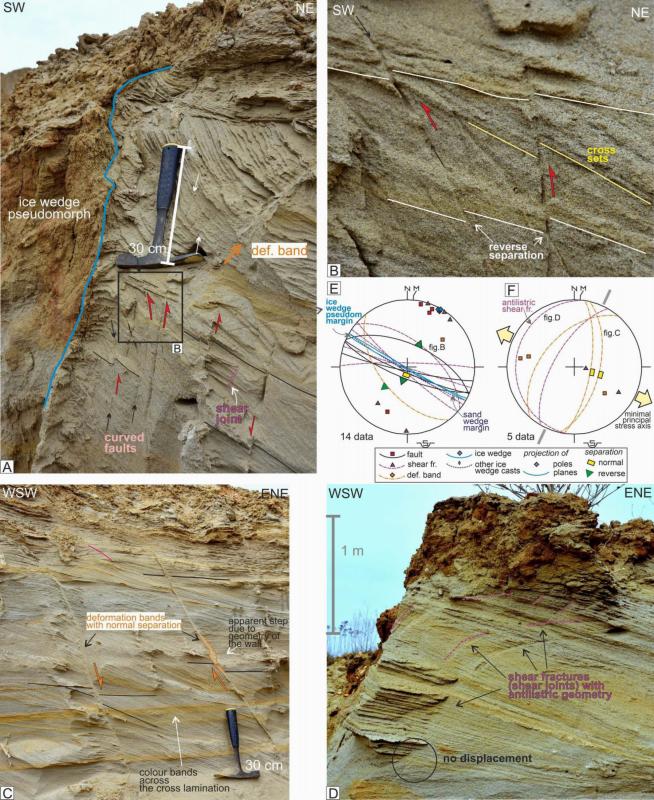
Concerning the study of past periglacial processes, the Pannonian Basin is a key area as it contains the southernmost frost polygons found in Central Europe. The presence or absence of permafrost is still, however, a matter of debate, and data on the timing of frost action are also scarce. In order to improve our understanding, we carried out extensive field work in NW Hungary, where periglacial features are most abundant. We documented and dated frost-related objects and surveyed frost polygons using remote sensing images. Relict sand wedges and veins, as well as ice wedge pseudomorphs, signs of segregation ice, and all known types of cryoturbation features were observed; ice wedge pseudomorphs are reported from the area for the first time. Ice wedges, large sand wedges, and several-meter-thick sediments deformed by segregation ice and cryoturbation features indicate the past presence of permafrost at nearly all field locations. The occurrence of steep, discrete shear fractures, often with reverse offsets, indicates frozen sediments during the shear-related deformation near the ice wedges. Overprinting of older features by new ones showed multiple phases of frost action, with the youngest features being small and probably caused by only seasonal frost. Luminescence dating provided Late and Middle Pleistocene (MIS 3, 6–5 and 7–6) ages for permafrost-related features. MIS 6 permafrost can be linked to the coeval advance of the Scandinavian Ice Sheet, which extended almost as far as the Pannonian Basin. On the basis of the known extent of ice sheets, the area could have experienced (sporadic) permafrost even in the LGM. Sand wedges from both MIS 3 and 5 are associated with polygon networks on the surface, suggesting that multiple periods of thermal contraction cracking shaped the modern land surface. Based on the immature pattern of polygonal surfaces, most thermal contraction cracking intervals were probably shorter than ca. 4 ka. Polygon networks indicate plateau surface stability for over 100 kyrs.
Vissza Tovább >