


Ság Hill is now one of the IUGS “Third 100” Geological Heritage Sites!
Hungary’s Ság Hill has been included in the “Third 100” list of the International Union of Geological Sciences (IUGS), which presents geological heritage sites of outstanding importance around the world. The international recognition is based on the hill’s significance in the history of science: it was on Ság Hill that Loránd Eötvös and his colleagues carried out the first field measurements with the Eötvös torsion balance.
On the list, Ság Hill appears alongside well-known geological sites such as Mount Fuji, the Norwegian fjords, the San Andreas Fault in the United States, Aconcagua in Argentina and the Chocolate Hills in the Philippines.
Ság Hill and the Eötvös pendulum
In 1891, on the summit of Ság Hill, which was then still roughly the shape of a truncated cone, Loránd Eötvös and his colleagues tested the Eötvös torsion balance under field conditions. The instrument is widely known as the Eötvös pendulum. It could detect, with remarkable precision, tiny gravitational variations caused by the geological structure beneath the surface and by the local distribution of mass.
The torsion balance was used in laboratory experiments, and it also opened new possibilities in geophysical field research. The instrument later became a pioneering tool in petroleum exploration, because it made it possible to study the gravitational effects of subsurface rocks and structures. For this reason, Ság Hill is an important site in the history of gravitational geophysical methods.
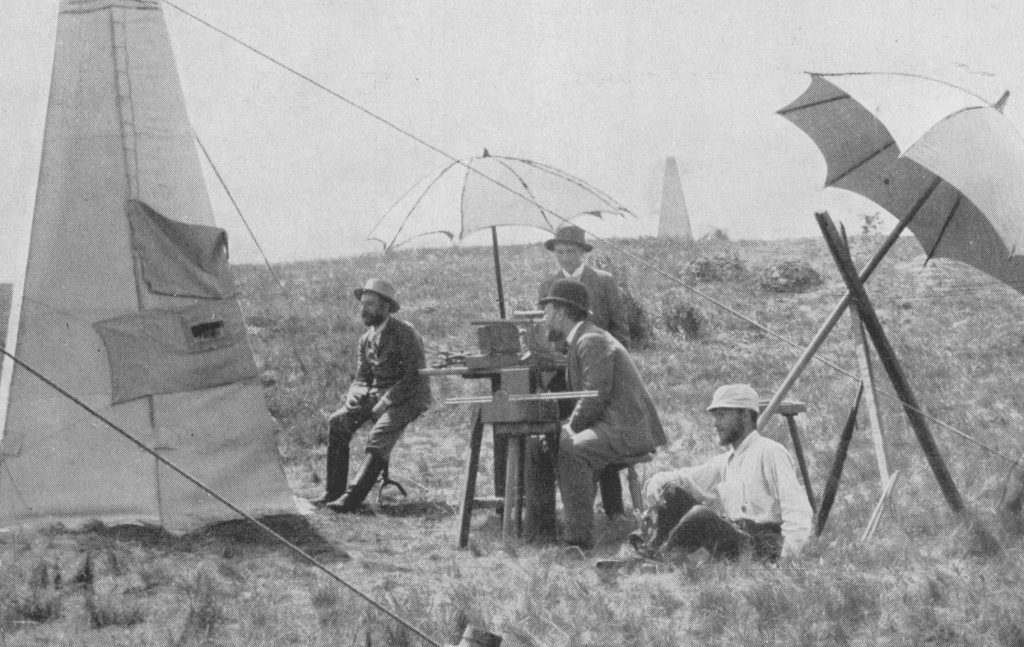
A photograph of the first field experiment has survived. It shows Loránd Eötvös seated on a chair beside the instrument, taking measurements through a telescope. Lajos Bodola sits in front of him and Radó Kövesligethy behind him, while Károly Tangl stands beside them. The original photograph is held by the Loránd Eötvös Memorial Collection of the Geological Survey of the Supervisory Authority for Regulatory Affairs (SZTFH).
The exact date of the photograph is uncertain: some sources give 2 August 1891, others 3 August. It was taken by József Krenner.
The scientific legacy of Loránd Eötvös
Baron Loránd Eötvös (1848–1919), physicist and geophysicist, made fundamental contributions to both physics and the Earth sciences. His research covered capillarity, that is, the surface phenomena of liquids, as well as gravitation. Using the torsion balance named after him, he examined the proportionality of gravitational and inertial mass with great precision, and his measurements had a significant impact on the development of applied geophysics.
Eötvös was also highly influential as a scientist, university teacher and organiser of science. He was President of the Hungarian Academy of Sciences from 1889 to 1905, and Minister of Religion and Public Education in 1894–1895. His name lives on in numerous scientific concepts, a unit of measurement and natural features.
The IUGS recognition of Ság Hill is a further international tribute to Eötvös’s legacy. In 2018, the European Physical Society designated the former Institute of Physics in Budapest’s Trefort Garden as an EPS Historic Site. That was where the laboratory experiments with the Eötvös torsion balance took place. Ság Hill, as the site where the instrument was first tested in the field, complements this scientific heritage.
How did Ság Hill form?
Ság Hill is the remnant of a volcano that was active about five and a half million years ago. It formed in several stages. During the early volcanic activity, magma rising towards the surface came into contact with groundwater. The water heated rapidly and turned to steam, triggering explosive eruptions. The rock debris thrown out built up a tuff ring around the eruption site.
Later, several vents opened inside the tuff ring, producing scoria cones and lava spatter. As the gas content of the magma decreased, the nature of the eruptions changed: lava reached the surface in increasingly large blocks and then spread out as lava flows. In the final stage of the hill’s formation, lava filled the interior of the earlier tuff ring.
The lava cooled slowly. Cracks that formed as it solidified penetrated deep into the rock body and created columnar jointing, the basalt columns typical of basalt, often called basalt organ pipes. Over millions of years, water, wind and frost wore away the softer surrounding rocks, while the hard basalt resisted erosion. This is how the butte that rises above the landscape survived.
Twentieth-century quarrying made the hill’s internal structure particularly easy to study. Quarrying removed a large part of the hill’s basalt cap and exposed the rocks, layers and structures formed during the volcanic activity. This exposure is also significant for geological research.
The history of quarrying
The basalt of Ság Hill was already used in antiquity. In Roman times, considerable quantities of stone were quarried here, among other things for road building. Large-scale quarrying began in the early 20th century, when road and railway construction created growing demand for high-quality stone.
The Ság Hill Basalt Quarry Company (Sághegyi Bazaltbánya Rt.) was founded in 1909, and production began in 1911. The basalt was used for road and railway construction and for paving town squares. The more easily worked basalt tuff was made into building stone. Quarrying remained significant during the Second World War, and the quarry closed in 1957.
Quarrying transformed the hill considerably, but it also created a geological exposure that still helps researchers study the volcanic structure and history of the hill today.
What does the IUGS “Third 100” recognition mean?
IUGS Geological Heritage Sites are selected for their outstanding scientific value and as exceptional examples of geological features, processes and discoveries. They are sites that have played an important role in our understanding of the Earth and its history, and in the development of the geosciences.
The “Third 100” is the latest stage of an international IUGS initiative launched in 2022. The first 100 sites were presented in Zumaia, Spain, in 2022, and the second 100 were announced in Busan, South Korea, in 2024. Since 2022, more than a thousand experts from 90 countries and 20 international organisations have taken part in the programme.
The new list includes 100 sites from 47 countries and several regions. Alongside Africa, the Americas, the Asia-Pacific region, the Middle East and Europe, Antarctica and the open ocean are also represented. The “Third 100” adds geological sites such as Mount Fuji, the Norwegian fjords, the San Andreas Fault, Aconcagua and the Chocolate Hills to the earlier lists.
Sites on the earlier lists include the Grand Canyon, Kilimanjaro, Mount Everest and the Namib Desert. The lists also draw attention to lesser-known sites. Examples are Siccar Point in Scotland, which played an important role in the recognition of geological time, and the Ediacara Hills in Australia, where early multicellular life forms were described.
Beyond its scientific significance, the recognition can also help promote and preserve geological heritage. International attention can increase appreciation of the sites, support their use in education, and help ensure that geological heritage is preserved for future generations.
The nomination of Ság Hill and the Geoheritage 2026 conference
The initiative to nominate Ság Hill came from the HUN-REN Institute of Earth Physics and Space Science. Prof. Károly Németh, volcanologist and chair of the IUGS subcommission on geological heritage sites, played a key role in the nomination. Two years earlier, the Bakony–Balaton region had been included in the IUGS “Second 100” list.
The Geoheritage 2026 conference on geological heritage, hosted by the Algarvensis Geopark in Loulé, Portugal, brings together 156 experts from 49 countries. The programme includes plenary lectures and presentations on IUGS geological heritage sites, rocks and geological collections. During the conference field trip, participants also visited the Telheiro Unconformity and the Monchique alkaline complex.
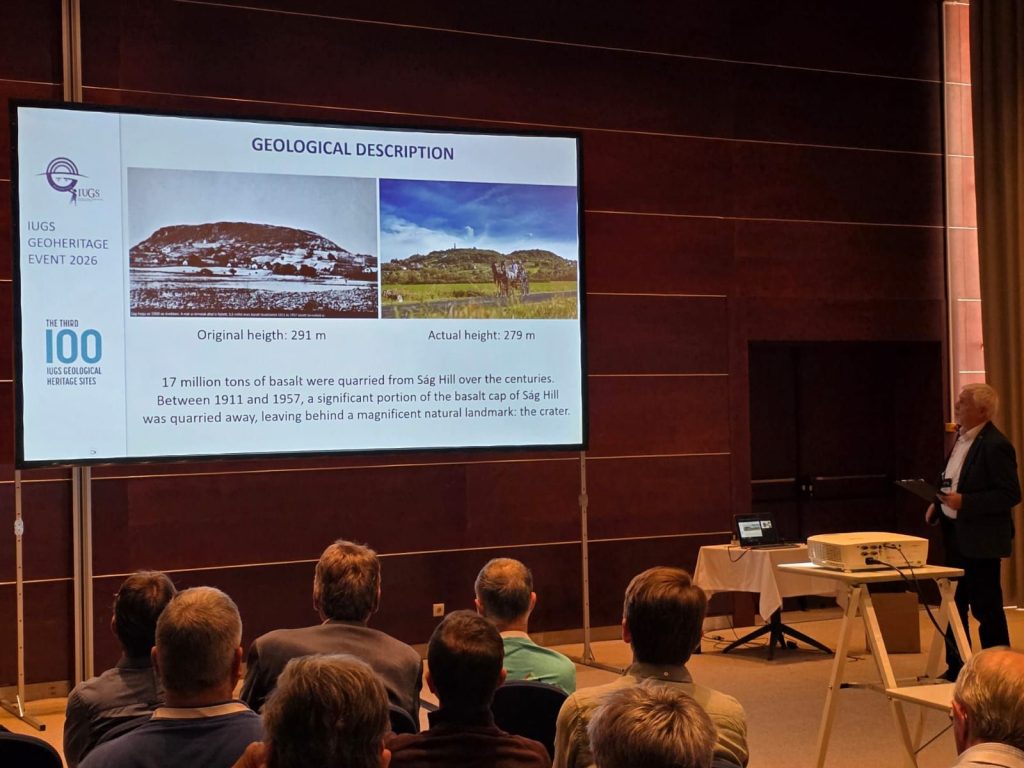
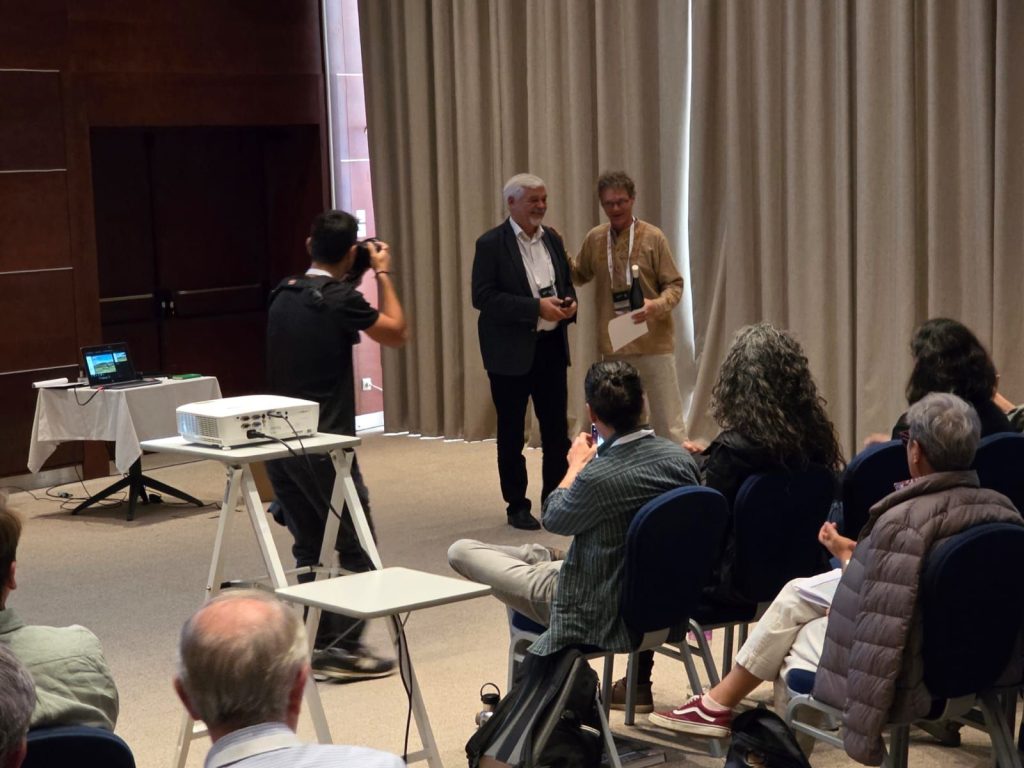
The presentation of Ság Hill was given on 4 November by Dr László Csaba Szarka, full member of the Hungarian Academy of Sciences. He is a former scientific adviser at the predecessor of the HUN-REN Institute of Earth Physics and Space Science, and chaired the coordinating committee for the 2019 and 2023 Loránd Eötvös anniversaries. His talk covered Ság Hill, the significance of the 1891 measurements in the history of science, and the life’s work of Baron Loránd Eötvös.
Further information and sources:
- The full list of IUGS Geological Heritage Sites and the publication “The Third 100”
- The geological nature trail of Ság Hill
- The history of Ság Hill and its basalt quarry – Kemenes Volcano Park
- More about the Ság Hill basalt quarry
- Lajos Kovács: A tribute to Loránd Eötvös’s gravitational measurements on Ság Hill
- A summary of the work of Loránd Eötvös