



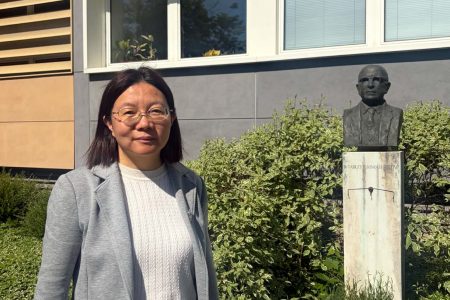
“If you want to protect the Earth, you have to understand what happens inside” – An Interview with Prof. Qin Wang, Structural Geologist and Rock Physicist at Nanjing University
Prof. Qin Wang grew up in the shadow of the Tianshan mountains, where a childhood spent climbing hillsides and collecting rocks set the course of her career. Today she is a professor at the School of Earth Sciences and Engineering at Nanjing University — one of China’s top nine research universities — where she has worked for over two decades. Her research sits at the intersection of structural geology and rock physics, exploring how minerals deform under extreme pressure and temperature, and mysteries about earthquakes, plate tectonics, and the long-term evolution of our planet. We spoke with her during her visit to Sopron, HUN-REN EPSS.
– You have spent more than twenty years at Nanjing University — as a student and now as a professor. What makes it so special?
– Nanjing University is a member of the C9 League — China’s nine leading research universities — and one of the country’s oldest, founded in 1902. Our School of Earth Sciences and Engineering just celebrated its 105th anniversary. What I find most valuable is the breadth of expertise under one roof: structural geology, geophysics, petrology, geochemistry, paleontology, hydrology, as well as engineering geology. If you have an idea and need a collaborator, you simply knock on a colleague’s door. The interdisciplinary culture makes the science richer.
As a public university, the majority of our funding comes from government sources — primarily the Ministry of Education, National Natural Science Foundation of China and the Ministry of Science and Technology — which cover salaries and core research budgets. At the same time, many faculty members maintain active industry partnerships. Research outcomes in areas like mineral exploration, new energy, and geological engineering feed directly into commercial applications, and the feedback from industry in turn sharpens the questions we ask. It is a productive loop between basic science and real-world needs.
– How does the university approach student education, particularly at undergraduate level?
– We recruit from the top five percent of students nationally, but we keep intake small — around 4,000 undergraduates per year — so we can invest in each one. For the first two years, students are not locked into a single discipline. They join a broader college grouping and sample courses freely before choosing a specialisation. If someone discovers after a year that Earth sciences is not for them and they prefer physics or computer science, they can transfer. We want students to make an informed choice, not an accidental one.
The real weight of the university sits at graduate level: roughly 19,000 master’s students and 11,000 PhD students. They have access to state-of-the-art laboratories and a wide range of international exchange programmes. Tuition fees are modest because we are a public university, and most graduate researchers receive a scholarship that covers their fees alongside a small research stipend.
– Nanjing University was also among the first in China to introduce AI courses university-wide. How do you approach AI in earth sciences?
– We treat AI as a tool, not a replacement for thinking. It is genuinely useful for analysing large datasets, surveying the literature quickly, and identifying research gaps. But students must understand its limits: AI can confidently cite references that do not exist or present false data, so everything must be double-checked. The rule we emphasise is straightforward — use AI to increase your efficiency, never to bypass your own reasoning. The genuinely new insights still have to come from you.
– You completed your bachelor’s and master’s degrees in China, your PhD in Canada, and have since collaborated across Europe and beyond. What has that international trajectory taught you about how different scientific cultures approach the Earth sciences?
– I started at Nanjing University in 1992, then went to Montreal to do my PhD in mineral engineering — and that move proved formative. Canada is a vast country with enormous stretches of geology that have barely been studied in detail, so there is a strong tradition of exploratory, discovery-driven fieldwork. The scientific culture is open and collaborative, and the standard of training is very high.
China has changed dramatically in the last twenty years. The government has invested heavily in Earth sciences — partly out of necessity, because the country needs to understand and manage its own vast mineral and energy resources — and that funding has lifted the entire field. The research community is large, competitive, and increasingly internationally connected. What used to be a gap between Chinese and Western science has narrowed considerably.
What strikes me most about Europe is the diversity — not just cultural, but geological and intellectual. European scientists tend to combine a deep knowledge of their local geology with a genuinely global perspective. They are often asking how their region fits into the larger picture of Earth’s evolution, and that comparative instinct produces very interesting science. I also find that European researchers are comfortable working across borders in a way that feels natural here — perhaps because the countries are small and the problems do not respect national boundaries anyway.
If I had to name one difference, I would say that in China the relationship between basic research and applied outcomes is very explicit — funding bodies want to see societal relevance, and researchers are used to articulating it. In some European traditions there is more room for purely curiosity-driven work without that pressure. Both approaches have real value. The best science I have seen combines both: a genuine intellectual question, and the awareness that the answer might one day matter to someone beyond the laboratory.
– Your core research concerns the role of water in rocks and minerals at depth. Can you explain why even trace amounts of water matter so much?
– Most people think of water as a surface phenomenon — rivers, oceans. But water can also be stored inside minerals, either as part of their crystal structure or hidden within defects in the lattice as hydroxyl groups. In the lower crust and upper mantle, minerals like olivine and pyroxene that contain no hydrogen in their standard formula can still trap water this way.
Even concentrations as small as 100 parts per million dramatically reduce the strength of those minerals at high temperature and pressure. A rock that would normally require enormous stress to deform flows much more readily when it contains trace water. This affects everything from the rate of mantle convection to the electrical conductivity of the deep Earth — properties we can measure remotely using geophysical methods. It helps us understand why some regions are seismically active while others remain stable cratons for billions of years.
– How does water connect to earthquake generation in subduction zones?
– Subduction zones — where one tectonic plate dives beneath another — are the most seismically dangerous regions on Earth. As the descending slab reaches greater depths, the hydrous minerals within it break down and release their stored water into the surrounding rocks. This raises pore pressure, and high pore pressure makes rocks fracture far more easily, even hundreds of kilometres below the surface. Think of shaking a champagne bottle: the pressure finds the weakest point and breaks through. That mechanism explains many of the deep and intermediate-depth earthquakes we observe in regions like northeastern Japan subduction zone.
– You have also served on the advisory group for the International Continental Scientific Drilling Program. Why does deep drilling still matter?
– Surface outcrops give you snapshots, not continuity. To read an unbroken record of how the crust evolved over millions of years, you have to drill. The deepest borehole ever completed — the Kola Superdeep Borehole in Russia, drilled during the Cold War — reached just over 12 kilometres in depth. Germany’s continental drilling project reached around 9 kilometres before heat defeated it: beyond roughly 265 degrees Celsius, the drill tools themselves soften and can no longer penetrate hard rocks. Despite those constraints, the cores retrieved have rewritten our understanding of crustal composition, fluid circulation, natural resources, earthquake processes, deep life and palaeoenvironment.
– What brought you to Hungary, and what kind of collaboration do you envisage with the institute here?
– I met Prof. Sierd Cloetingh through the International Lithosphere Program, and he spoke highly of the EPSS institute’s work. Our two organisations signed a collaboration agreement last year focused on seismology, deep structure, sedimentary geology, and palaeontology. My visit was a first step — I gave a seminar, met colleagues, and began mapping out where our interests genuinely overlap.
Concretely, we are planning a joint field excursion course in western China this year, which Hungarian students are welcome to join. We also hope to bring colleagues and students from both sides together for workshops, because in science, informal conversations around a shared problem are often where the real ideas begin.
– If you could leave the general public with one message about why understanding the deep Earth matters, what would it be?
– Everything we see at the surface — the shape of mountain ranges, the location of oil and gas fields, the distribution of mineral deposits, the pattern of earthquakes — is controlled by processes happening deep inside the Earth, playing out over millions of years. If you want to use natural resources wisely, reduce the damage caused by natural hazards, or develop cleaner energy like geothermal power, you first need to understand what is happening beneath your feet. The deep Earth is not an abstract scientific curiosity. It is the engine that built the world we live in, and it is still running.