



Raspberry Pi based data logger
Applied for utility model protection at the Hungarian Intellectual Property Office on 14-10-2025.
Low-power, modular and autonomous Raspberry Pi-based data logger
The data logger system developed at HUN-REN EPSS can operate in unfavourable infrastructural conditions: without an established internet connection, in lack of mains power supply and even in the absence of frequent visits to the site of operation. The Linux OS running on the platform provides flexible programmability and a high level of system integrity. Thus, the measurement control of the attached sensors can be completely configured according to the user’s needs, directly by the user. Since the system itself is a full-fledged computer, not only data recording, but also pre-processing, displaying and data transmission can be implemented as desired. The modular structure of the system provides a high level of expandability in terms of functionality. The measurement status can be monitored remotely, and in case of a problem, the data logger can also be accessed remotely. The measurement data can be transmitted to a data centre via wired or mobile internet. The frequency of the battery replacement at places where mains power supply is not available can be efficiently minimized by the application of a solar panel charging system.
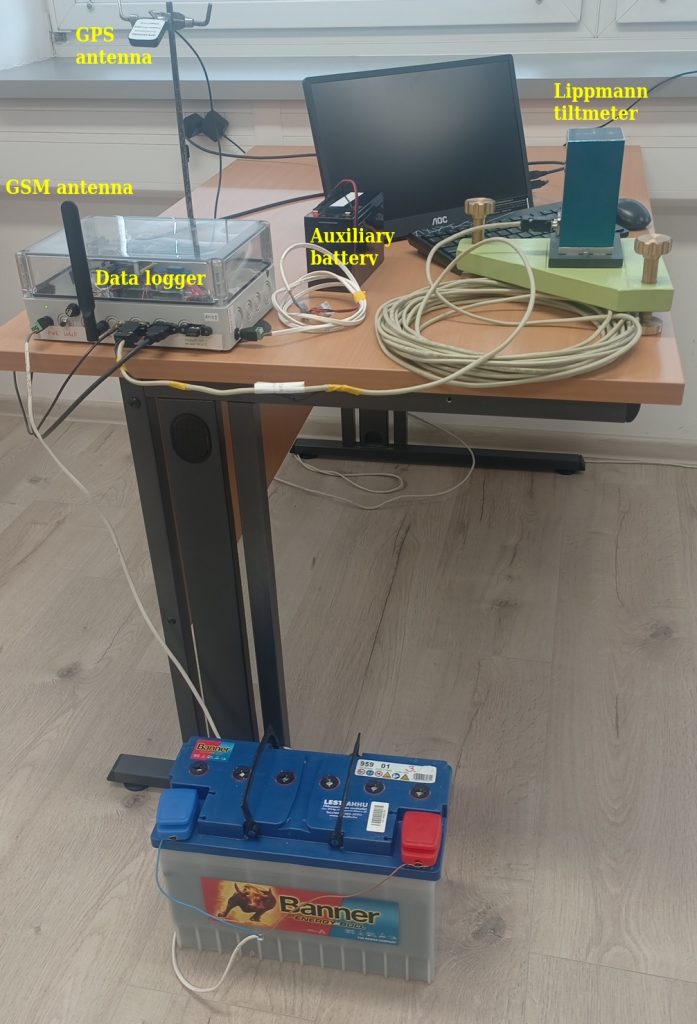 The first version of the data acquisition system for controlling the Lippmann HRTM tiltmeter |
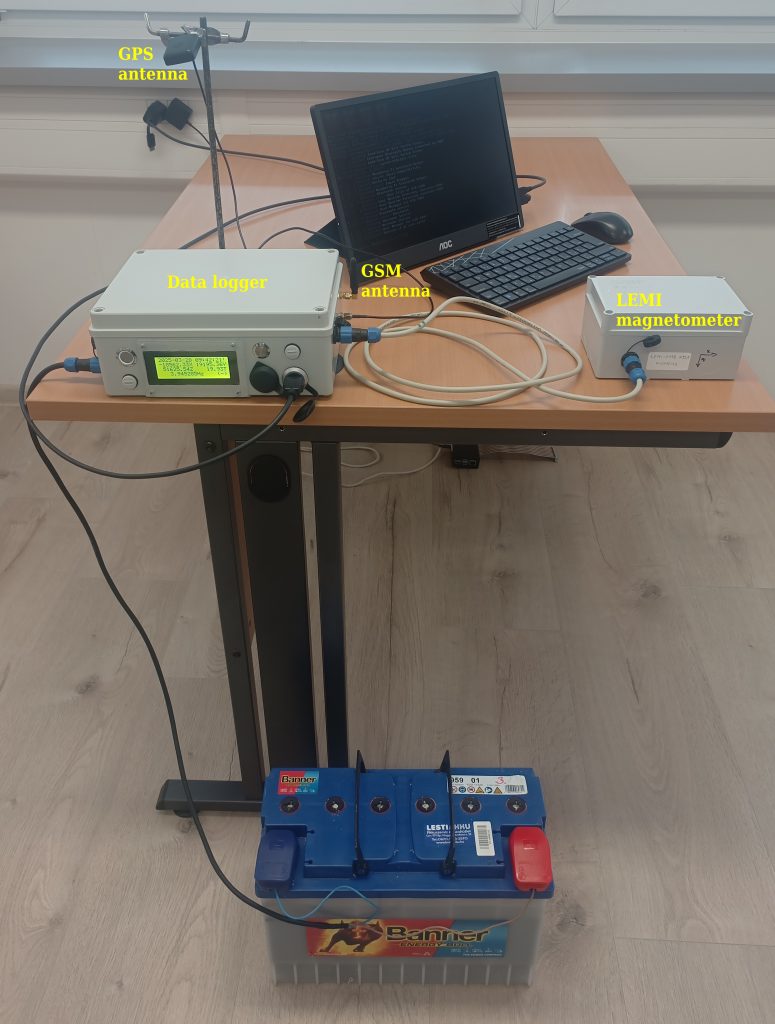 Second version of the data acquisition system for controlling the LEMI magnetometer |
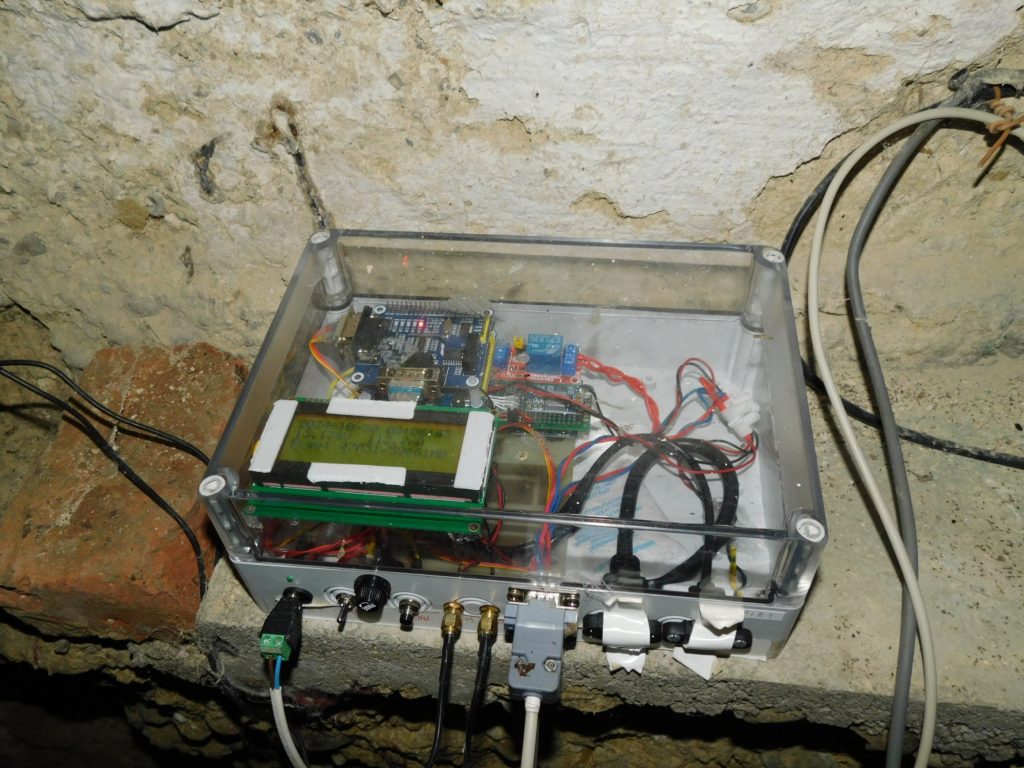 The first version of the data logger system in operation at the Brennenbergbánya measuring station (BREBA)
Features adjusted for field use
For continuous measurements to be carried out in unfavourable field conditions, an autonomous data logger, operable with minimal infrastructure is needed. It must be capable to temporarily stores the data provided by the sensors and transmits it to data centres at the necessary frequency. In field conditions of geoscience research, it often happens that there is no available electric power or internet at the measurement site, and there is no possibility to visit the site frequently to access and download the recorded data. In this case, a microcomputer with minimal power consumption must be able to operate for a longer period of time (up to a month) from a so-called working battery, which reads the analog or digital signal out from the instrument, digitizes and stores it, or, if there is adequate mobile network coverage, transmits it to a data centre via GSM internet link. If the remote access of such a measuring station is very limited (due to e.g. slow GSM internet service), the data logger must be able to send status messages at regular intervals. This way the user can monitor its operating status and intervene remotely if necessary (e.g. using command SMS messages). At a suitable location, a solar panel can be used to charge the battery to minimize the number of battery replacement required. The continuity of data collection during such operation is ensured by an auxiliary battery connected to the power supply system via integrated circuits. This way, the system does not have to be shut down for the time needed by the replacement.
Flexibility, cost-effective and autonomous operation
Commercially available data loggers that can be used in difficult field conditions are expensive and in many cases have limitations in some aspect (e.g. speed or format of data acquisition). The former has a negative impact on the budget of research projects and the latter sometimes on their professional results. To solve this problem, the professionals of EPSS developed a cost-effective, modular, freely expandable data logger based on Raspberry Pi technology. Remote monitoring of the system and data transmission to the data centre is solved with the application of a GSM module. The data logger can send status messages via SMS and can also receive commands via SMS (e.g. OS restart). If the signal strength is adequate, the mobile internet can also be used for remote desktop access and data transmission. A GPS receiver module can be used to determine the exact time, otherwise the time of the data logger’s clock can be synchronized to the UTC (Coordinated Universal Time) system via mobile internet using NTP (Network Time Protocol). To minimize energy consumption, a low-power Raspberry Pi motherboard, expansion modules and components were carefully selected, tested and integrated in the system. Programming and timing procedures were developed to save energy by turning on the GPS and GSM modules when they are really needed. Data can be retrieved from the instruments via a serial (RS232) port, but other types of data transmission methods, e.g. by integrating an analogue-to-digital (A/D) converter can be provided as well.
Motivation and development phases
The development of the data logger system was initiated by the fact that the Geodesy Research Unit of HUN-REN EPSS , that time still an institute of the ELKH, received infrastructure development support from the Eötvös Loránd Research Network in 2020 for the purchase of 4 high-sensitivity Lippmann 2D HRTM tiltmeters (Lippmann Gmbh, Germany) and for the establishment of a measurement network to monitor seismo-tectonic deformation processes of the Mur-Mürz tectonic fault zone (see kepujsag.ggki.hu). The extremely stable environment required for the measurements can only be ensured in underground facilities, where IT tools and data transmission procedures optimized for the usual office environment may not be applicable. The project could no longer finance the purchase of a suitable data logger for the tiltmeter, but one that meets the needs was developed from the available budget. The data logger is currently available in versions prepared for the data acquisition control of a nanoradian sensitive 2D tiltmeter (Lippmann HRTM) and a fluxgate magnetometer (LEMI-011B) for measuring the geomagnetic field and equipped with the appropriate interfaces. In both versions, a 4-line LCD display and a single push button allow some basic, pre-programmed operations and configuration settings to be performed without connecting a monitor and keyboard to the logger. The current measurement data can be recorded on a microSD card or downloaded to an external data medium. A monitor can be connected via an HDMI connector, and an additional data medium (e.g. pendrive) or other USB device can be connected via a USB connector. The coaxial connectors ensure that external GSM/LTE and GPS/GNSS antennas installed in a location providing adequate signal strength can be used for GSM data transmission or for clock synchronization based on receiving of GPS time signals, if necessary. This is especially important in situations where the measuring system has to be operated in underground objects where microwaves no longer penetrate and there is no internet access. In the practice of earth sciences, such a situation may arise primarily during measurements in caves, abandoned mine shafts, and tunnels. The device housing, which is a standard plastic mounting box used in electrical engineering, is dust and water resistant to a certain extent. The data logger is currently at the prototype development stage. Since it is a complete computer operated under the so-called Raspbian Linux OS, its user can develop and customize the software required for controlling the measuring system, data transmission, and pre-processing of the data as desired. Various programming languages (e.g. Python, C++, FreeBasic, FORTRAN) are available for these tasks, ensuring the greatest degree of flexibility in programmability and ultimately in applicability. In addition to the data acquisition and measurement control program, codes for timed data transmission and display were also developed for the Lippmann tiltmeters. Today’s IT technology allows the system to function as a full-fledged computer at the measurement site if necessary, using a small, portable monitor and keyboard with built in battery. The different versions of the data acquisition system were designed, manufactured, configured and tested by Csongor Szabó (IT specialist) and Tibor Molnár (electrical engineer specialist), employees of the EPSS in Sopron, according to the requirements and instructions of Dr. Gábor Papp (EPSS Geodesy RU) and Dr. István Lemperger (EPSS ZBL). Dr. Gábor Papp coded the measurement control and data acquisition program, as well as the data transmission and display programs, required for the Lippmann tiltmeter.