

Interview with Claudia Martinez-Calderon about VERSIM School 2026
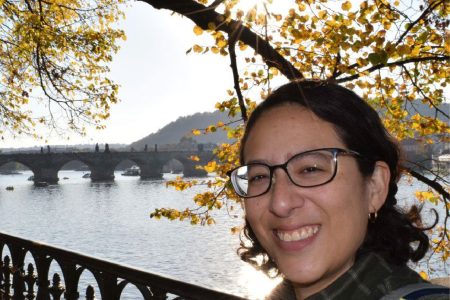
Dr. Claudia Martinez-Calderon is an Associate Professor at the Institute for Space-Earth Environmental Research (ISEE) at Nagoya University, Japan. A specialist in space physics and magnetospheric plasma waves, her research focuses on the properties, propagation, and generation of Extremely Low Frequency (ELF) and Very Low Frequency (VLF) emissions, specifically how VLF and ELF plasma waves propagate and interact with high-energy electrons trapped in Earth’s radiation belts. Claudia currently serves as the international URSI Co-Chair for the VERSIM working group, where she also co-founded the community’s international Journal Club and the VERSIM School, which she established in 2022 for early-career researchers to get hands-on training from VERSIM leading space physicists.
What is space science, and why is it worth studying to become a space researcher these days?
For those of us in the space physics community, and specifically the VERSIM workgroup, our primary interest is the near-Earth space environment. We focus heavily on the ionosphere and magnetosphere of our own planet, though we also investigate other worlds like Jupiter or Mercury. Ultimately, we are trying to understand space weather: just like your everyday weather forecast, but for the space environment surrounding Earth. We track how solar wind and geomagnetic storms trigger massive plasma dynamics right above our heads, as these are phenomena that can easily disrupt satellite communications, disturb GPS systems, or even take down entire power grids on the ground. VERSIM stands for VLF/ELF Remote Sensing of Ionospheres and Magnetospheres. Basically, we use Very Low Frequency (3–30 kHz) and Extremely Low Frequency (300 Hz–3 kHz) radio waves as a proxy to understand what is happening thousands of kilometers away in space. By studying how these waves behave, we can get a better understanding of the upper atmosphere, plasma structures, and complex wave-particle interactions among other things.
So, why is it worth going into this field right now? I think because we are currently living in a kind of “golden age” of space data. As a researcher today, you have access to an unbelievable amount of data from space missions like Arase, MMS, THEMIS, and the Van Allen Probes. But also, an incredible array of ground-based tools like EISCAT, ionosondes, VLF receivers, magnetometers, and all-sky cameras. On top of that, we have an insane amount of computing power at our disposal. We are actively integrating advanced numerical simulations, data assimilation, and machine learning to understand the world around us. If you’re a student with a love for physics and coding, you can join us and for example, make a tangible impact on global space weather models that protect human infrastructure in space. At VERSIM, we are literally using our planet’s own natural radio signals to decode the magnetic shields protecting us, which I think it’s really cool.
What is the VERSIM School about?
Back in 2022, I realized that while our workshops were fantastic for senior scientists, our graduate students and early-career scientists sometimes felt a bit left out or unsure of how to approach more senior researchers who all knew each other. I thought the school would help bridge that gap by giving these early-career scientists more one-on-one time with established scientists in our field. I also believed that through the lectures, they would benefit from an intensive crash course in VLF/ELF remote sensing before the main scientific meeting started. This way, everyone would be able to follow and understand the many diverse topics discussed within our community.
This year in Sopron, we tried to provide lectures covering all the core topics of the upper atmosphere alongside basics of plasma waves. We had Balázs Heilig and Veronika Barta (HUN-REN EPSS) breaking down the dynamics of the plasmasphere and the ionosphere, with Gabriella Sátori (HUN-REN EPSS) explaining the complexities of Schumann resonances. Dedong Wang (GFZ Potsdam) taught the theoretical framework used to study and quantify plasma waves. Ondrej Santolik and Ivana Kolmasova (IAP CAS / Charles University) then discussed how to isolate and analyze wave data directly from observations. For my part, I gave a methodology tutorial on how to write grant proposals and improve presentations by focusing on accessibility, such as choosing appropriate color palettes for color-blind individuals. This was complemented by a visit to the Széchenyi István Geophysical Observatory, where the students saw the instruments used to measure Earth currents, atmospheric electricity, ionospheric sounding and Schumann resonance monitoring,
I think what really makes this school special isn’t just the lecturing, but the unique environment we create. We don’t just stick to traditional presentations; we also provided tutorial blocks where we sit down with the students, analyze real data, and take the time to answer their specific questions. Between the coffee breaks, group lunches, and our field trip to the local geophysical observatory, the students are spending days casually interacting with the exact people who are writing the textbooks in our field. This helps to make the distance between them smaller every day, and hopefully inspires them to continue to actively participate in our community.
How would you rate the success of this year’s edition, and when will the next school take place?
I think this year’s school was an even bigger success than our first one. The inaugural VERSIM school in Finland back in 2022 had just 14 participants (including lecturers), but this time we had a total of 25 people representing 8 different countries.
But more importantly for me was the incredible level of engagement. We intentionally built long coffee breaks into the schedule, and the students really took advantage of them for discussions. They even set up a WhatsApp group entirely on their own to keep in touch during the workshop and coordinate group dinners. At our social gathering, so many people stayed way past the official ending time just to keep chatting.
The feedback from the students was honestly the most rewarding part. Several of them came up to tell me how happy they were with the school because it was just so informative. They learned a ton of new concepts, and some told me that incredibly difficult physics topics finally clicked for them because our speakers did such a phenomenal job explaining things. They absolutely loved having so much dedicated time to just hang out, talk, and engage.
Our next school is planned for 2028, during the next VERSIM workshop to be held in Sendai, Japan. We hope to keep a similar format and keep the engagement going.