


Blue Pixies in UHU Experiment Observations
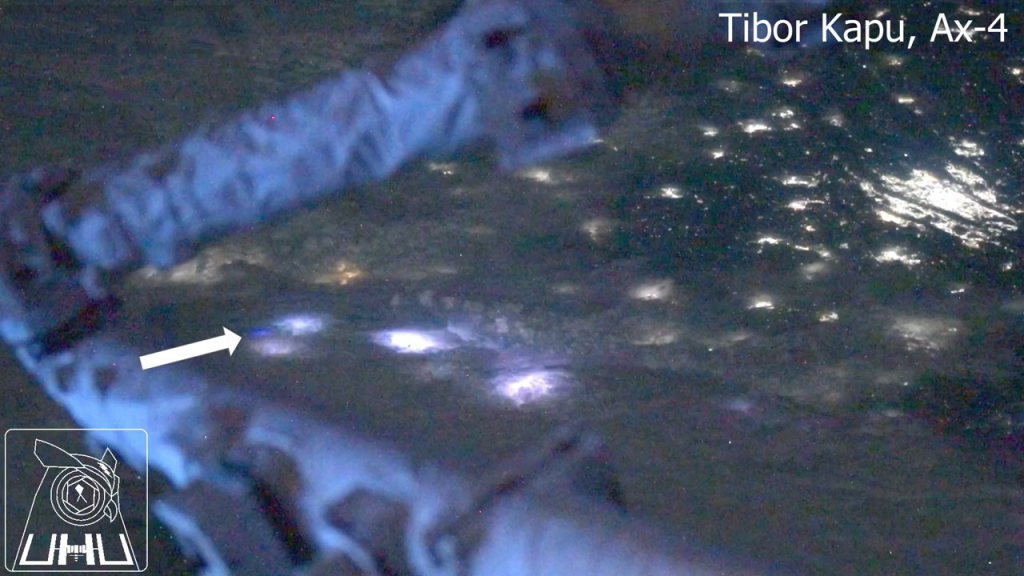
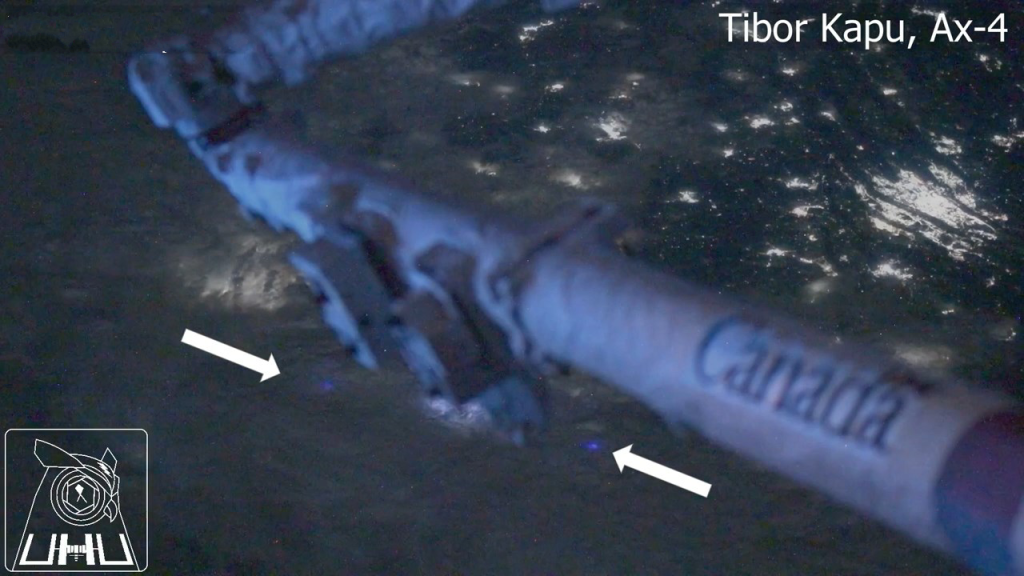
We have already reported on the ELVES (ring-shaped transient luminous events) detected from the International Space Station during the Axiom Space Ax-4 mission. Now, another type of transient luminous event (https://uhu.epss.hu/en/tle-phenomena/) has been identified within the observational material of the UHU experiment, led by the HUN-REN Institute for Earth Physics and Space Science.
The pixie, also known as a blue emission, or simply ‘blue’, is a short-lived variant of corona discharges. These flashes typically form at or near the top of an active thundercloud. Although their name originates from early long-distance observations where they illuminated only a single camera pixel, this phenomenon can extend across several square kilometers (Yair et al., 2024). Blues can therefore rightfully be regarded as members of the “giant TLE club,” alongside red sprites, ELVES, blue jets and gigantic jets.
For a blue pixie to form above the cloud top, a strong electric field is required between a region of suddenly emerging charge excess within the cloud and the invisible electric screening layer that surrounds the cloud tightly.
The screening layer consists of atmospheric free ions (space charge) drawn toward the cloud by its overall electrical field. The significant charge excess necessary for producing blue emissions is associated with a special type of intracloud lightning known as the compact intracloud discharge (CID) or narrow bipolar event (NBE). These terms reflect their distinct characteristics compared to typical lightning discharges observed in thunderstorms. CIDs are extremely short – lasting only a few hundred microseconds – and emit relatively little light, yet they are highly energetic. In the high-frequency radio band (3–300 MHz), they are the strongest radiating sources among the various lightning types (Bandara et al., 2021). Their altitude of occurrence can be used to characterize the strength of the convective intensity of the thunderstorm (Suszcynsky & Heavner, 2003).
While global monitoring of high-frequency radio waves is not currently feasible, the detection of blue emissions from space offers an excellent opportunity to study thunderstorm intensity and meteorological properties on a planetary scale. In accordance of the scientific aims of the UHU experiment, the identification of blue pixies contributes to answering the corresponding scientific questions following detailed analysis.
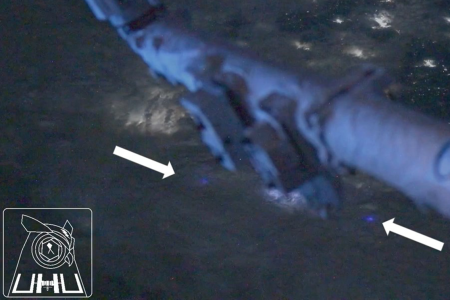
Blue pixies photographed from the International Space Station above China on July 4, 2025. Image detail from recordings by astronaut Tibor Kapu, Axiom Space’s Ax-4 mission.