



Science Underground — A Visit to the Sopronbánfalva Geodynamic Observatory
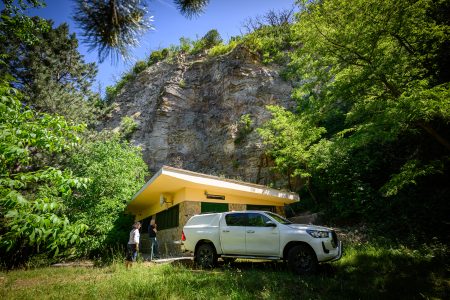
Deep beneath the forests of Sopronbánfalva, in a tunnel system built in 1962, instruments are at work monitoring the Earth’s movements — movements imperceptible to human senses — and their geophysical effects. From the outside, the Sopronbánfalva Geodynamic Observatory on Szikla Street looks like an unremarkable building. Inside, however, research of international significance is underway.
Dr. Gábor Papp, head of the Geodesy Research Unit at the HUN-REN Institute of Earth Physics and Space Science in Sopron, guided our team through the facility and showed us how — and with what instruments — scientists measure the periodic and transient deformations of the Earth’s solid body.
“The instruments installed here continuously monitor the deformation and motion of local rock masses,” the researcher explained. Among the instruments in permanent operation are a 20-metre quartz-tube extensometer with in-house-developed electronics, which has been recording rock expansion and contraction for over 20 years; an Earth tide gravimeter similarly enhanced with proprietary developments; and a tiltmeter capable of detecting the tiniest inclinations in both the north–south and east–west directions. All of the instruments can sense changes in their measured parameters at the nano-scale (10⁻⁹).
One of the most dominant sources of deformation is the tidal phenomenon. It is not only sea levels that change under the varying gravitational pull of the Moon and Sun — the shape of the solid Earth does too. “Right now, as we stand here, the ground beneath us is continuously rising and falling,” said Dr. Papp Gábor. Although we feel nothing of this, the vertical movement can reach plus or minus half a metre. The resulting local deformation is so minute relative to the size of the Earth that it can only be detected with highly sensitive instruments — though today it also shows up in data from satellite positioning systems such as GPS. An InSAR reflector installed on the observatory grounds further assists in detecting local surface changes; the Sopron institute played a leading role in its development.
The observatory is also an important station of the Hungarian National Seismological Network. Its broadband seismometer, together with Hungarian, Austrian and Slovak stations in the region, records both distant and local earthquakes. The source of local seismic activity is the Mur–Mürz fault zone, which crosses Burgenland and remains active today, connected to the junction of the Eastern Alps and the Pannonian Basin. “When elastic energy accumulates during the movement of tectonic plates, it is eventually released in the form of an earthquake,” said the observatory director. Major earthquakes are fortunately rare in the region, but the instruments detect even the slightest tremors.
The 40-metre tunnel has a unique microclimate. The sealed tunnel system, maintained to ensure undisturbed measurements, provides a stable environment. As a consequence, radon gas — which seeps naturally from the surrounding rock — accumulates in the tunnels. Researchers can therefore only enter certain sections with protective equipment. Radon concentration is also continuously monitored by a dedicated instrument.
During our visit, measurements were underway at the observatory’s benchmark point of the Hungarian National Gravity Network as part of an international experiment. Polish researchers were working with a quantum gravimeter — a brand-new device developed by French scientists over the past decade with European Union funding. The instrument is valued at approximately 200 million Hungarian forints.
“Although the underlying principle of measurement — observing the motion of a body in free fall in a vacuum — has not changed, older instruments drop a macroscopic object (a laser-reflecting prism) and calculate the gravitational acceleration from its movement. In this instrument, it is not a solid object that falls freely, but a quantum cloud,” explained Dr. Papp Gábor. By tracking the motion of this atomic cloud using quantum interferometric methods, the local value of gravitational acceleration can be determined with extraordinary precision.
This may sound theoretical at first, but it has very practical implications. Subtle, location-dependent variations in gravity can reveal subsurface rock density inhomogeneities, geological structures, cavities, mineral concentrations, or even magma movement in volcanic areas. Gravimetry is therefore an important tool in Earth science research, including mineral exploration.
The Sopronbánfalva site is particularly well suited to these measurements. “This is a very good location,” said the researcher, as he and his Polish colleagues analysed the quality of 24 hours of gravimetric data. The solid rock mass surrounding the observatory and the calm environment meant the instrument performed even more accurately than the manufacturers had promised. During a two-hour measurement sequence, they achieved noise levels that surprised even the researchers.
A joint project was launched last year with researchers from the Wigner Research Centre for Physics and staff from the University of Sopron to carry out a highly precise survey of the observatory’s surroundings. The university experts are conducting a detailed geodetic survey of the surface and the tunnel system, while the physicists are using a muograph of their own development to scan the rock mass above the tunnels in search of potential inhomogeneities and fault structures. The result will be a 3D model to serve as the basis for further investigations.
International collaborations are a regular occurrence at the observatory. New prototype instruments are periodically brought here for testing — radon detectors, hydrogen sensors, and other specialised devices. The goal is always the same: to understand the Earth’s dynamics and its relationship to its internal structure as precisely as possible.
Although the underground tunnels are not open to the general public, the observatory warmly welcomes groups of interested students and visitors. The researchers believe it is important for people to connect with scientific work that, though literally hidden beneath the ground, reveals a great deal about the planet we live on.
Full article: https://www.kisalfold.hu/helyi-kozelet/2026/05/fold-alatt-obszervatorium-sopronbanfalva-geodinamika