


“Dare to Dream”: A Conversation with Prof. Liane G. Benning
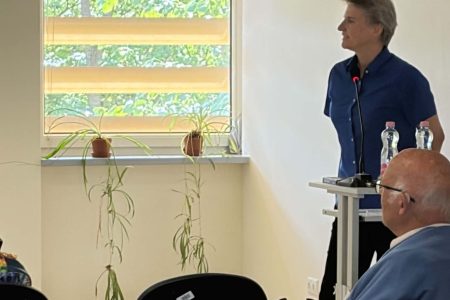
Professor Liane G. Benning, a biogeochemist at the GFZ Helmholtz Centre for Geosciences in Potsdam and Freie Universität Berlin, visited the HUN-REN Institute of Earth Physics and Space Science in Sopron in early June as part of the European Association of Geochemistry’s (EAG) Distinguished Lecture Tour. We took the opportunity to speak with her about her research, her passion for Earth’s most extreme environments, and the advice she has for the next generation of geoscientists.
You are here as part of a European Association of Geochemistry programme. Can you tell us about it?
The European Association of Geochemistry has organised, for the last ten years, what is called the Distinguished Lecture Programme — where we allow various universities or research institutes, primarily from the eastern part of Europe, to invite lecturers to give talks on the science they do that is of interest to he respective hosts. I was very honoured to have Dr. Márta Berkesi, who is a councillor of the EAG, invite me to Sopron to talk about my work.
Your work sits at the intersection of geology, chemistry, and microbiology. How would you describe what you do to someone with no background in these fields?
Generically thinking about how our planet works: it’s about bonds between elements being made and broken. Whether that’s between H₂O molecules in water, or how a water molecule reacts with a mineral, or how a microbe interfaces with the water or with the minerals — it’s all about reactions at interfaces. It doesn’t matter whether the reaction happens in the soil, on Mars, in the deep biosphere, or at the Earth’s surface, because everywhere you have water-mineral interactions, and at the surface, more microbe-mineral-water interactions. It is about biogeochemical processes, because they all work together. Over the years I learned that ignoring one is a problem. So we’re trying to figure out which one is more important under which conditions.
You study extremophile microorganisms — life forms that thrive in glaciers and on snow. What drew you to these places?
I went as a master’s student to Svalbard to study rocks — I was doing metamorphic petrology. And when I got there I saw all this snow and ice, and then I discovered that it is not lifeless. There’s lots of living stuff on snow and ice, which fascinated me, because I thought: if something lives there, which is basically pure water, they have to get nutrients somewhere, they have to make reactions. And I utterly fell in love with the Arctic. I thought, I have to do some science that takes me back there. It took many years — almost 13 years after my master’s before I went back, because as a student you don’t have the money to just say ‘I’m going to the Arctic.’ But then it happened, and I’ve been going back ever since.
In one way snow and ice is a simpler environment than soil; in another way it’s more complex, because it changes constantly — melting on a daily rate — while soil changes much more slowly. So it’s a different kind of challenge.
Your team works both in the laboratory and in the field, including Greenland. How do those two sides complement each other?
In my team — we are about 20+ people — all do laboratory work but many also do field work – the pure lab people are always jealous when the field people leave. But most often I have projects where you need laboratory experiments to validate and mimic the processes you see in the field. I go into the field because it doesn’t just help me solve a problem I see there, it also gives me questions: how can I design an experiment to test a hypothesis that explains what I’m observing? Nature is very complex, so in the lab I try to simplify things to isolate one process at a time.
A concrete example: we observed in the field that algae react to light. That meant we had to figure out how to culture those algae, keep them happy, and then run experiments in an incubator where we control the light and the nutrients — to see whether they do the same as in the field. It’s not trivial, but that’s why you always combine lab work and field work.
One of your key research areas is the darkening of the Greenland ice sheet. Why should the general public care about this?
Because if we understand how, why, and at what rate the ice in our polar ice caps or glaciers is melting, we can predict more accurately at what rate sea level is rising. We all know that temperature rise in the Arctic — based on measurements over many decades, from satellites and from stations — is four times faster than everywhere else. Ice melts when it’s warm. That melting induces sea level rise, which for hundreds of millions of people at the coast will have an effect. We’re looking at predictions to 2100, 2200 — long term — because the rate at which it happens is unprecedented. It’s not the fact that ice melts, that has happened throughout geological history, but the speed.
The microbes we study — particularly algae — have always been there, they’ve always thrived. But because the melt season is lengthening, there are more days when there is liquid water, more days when the microbes are active, more days when they can bloom and contribute to further melting. Will it totally change the way we understand the process? No. But if we have accurate rates of their contribution, we can put that into global models that predict what happens in the future.
And the implications go further: more melting affects ocean circulation, which affects atmospheric processes — more droughts, more rain, more storms. That is not what we study directly, but that’s the big picture. The reason a normal taxpayer should care is that fundamental research like this underpins our understanding of processes that can, at some point, have industrial or societal applications. Most societies invest in fundamental science because that’s what makes everything else work.
You have also been involved in developing instruments to search for life in environments analogous to the surface of Mars. How does your Earth-based research connect to that?
This happened by me because I started working in the Arctic and then being asked by a colleague who was developing technologies for Mars rovers to go with them to Svalbard to test those instruments in the field. I had the knowledge of the environment; they had the instruments they wanted to test. For about ten years I worked with ESA and NASA people, going to the Arctic to test rovers and instruments that are now on Mars.
At the fundamental level, it’s the same question. On Earth you have rocks, minerals, fluids, and microbes. On Mars you have minerals and fluids — and we want to see how that works, and whether life was ever involved. The processes we see on Earth today cannot exist without life. Why should this particular accident of life have happened only here? Somewhere else it may have happened differently. That is the question that drives it. It’s mostly my personal science — not many of my group work on it — but I work with colleagues in the US on this kind of research. That’s my fun.
You have spent most of your career outside Germany — in Switzerland, the United States, and the UK for over twenty years. How do you see differences in scientific culture?
I think we are still very lucky and privileged in Europe, whether Western or Eastern, to have the support of our governments for science. That is something we shouldn’t take for granted — I see it very clearly when I work with students from countries where they cannot receive this level of support.
But in terms of culture: when I went to the United States, I encountered a place where everybody is taught that you can solve the equation of the world. Coming from a European education system, which tends to keep people a little more in their lanes, that helped me realise I was equally capable — I was just trained to be a bit more afraid of daring. So now I try to teach my people to be a bit more daring. Not in a negative sense — just to dare to dream. To dare to think: what if I can solve this problem?
What would you tell students or early-career researchers thinking about entering this field?
I always say it doesn’t matter what you start with. You could be an architect. I have physicists and chemical engineers in my group. I started as a metamorphic petrologist — a very different field from what I do now. But it was always about reactions and understanding how things happen. When you do a master’s or a PhD in the natural sciences, you don’t just learn biology or chemistry — you learn to solve a problem, to take it apart and solve it.
So: be the best at whatever you are studying right now, but don’t think that your master’s or PhD defines the rest of your life. Talk to people in other fields. A question from someone outside your discipline will make you think: have I missed something? Have I not explained something right?
Be curious. Never stop learning — I spent the last two years learning about proteomics, having started with metamorphic petrology. And accept failure. You fail, but as a scientist you have the privilege of having an idea, getting it funded, and actually carrying it out. Not many other jobs offer that. Cherish it.
Networking and cross-disciplinary collaboration seem essential in this kind of work — yet research institutes can be quite siloed. How do you see that?
You are fully correct, and it is a real problem. The way institutions are built everywhere in the world, we tend to work in silos. It takes a lot of effort to go out and say, ‘Hey, what would you do?’ Because you have to trust somebody to ask the question — many people are afraid that their question might sound stupid. But there is no stupid question. It’s worse not to ask.
And interacting with people in different fields takes time, because you always have to learn a new language. I did my PhD in hydrothermal geochemistry — at the time for me, ‘hot’ meant 300 degrees. For a petrologist, ‘hot’ means 1,200. Now hot for me may mean 37oC. We use the same word and mean something completely different. Finding that shared language, and building the trust — that takes time. There’s a saying I love from my years in England: you do science well with people you also drink well with. Go to the pub, have the discussions, build the trust — and then the science follows.
Is there anything you wish someone had told you at the beginning of your career?
I wish somebody had told me that there are no boundaries. In European education we are taught to stay a little too much in our lanes. The system teaches you to do certain things in a certain way. When I went to the States and saw people who were trained to believe they could solve any problem, it helped me realise I was equally good — I was just trained to be a bit more afraid of daring.
Now I try to teach my people to reinvent themselves, often enough to still be excited about what they do. Allow yourself to change, to think about yourself in a different context. I find that exciting. And: study whatever you study, be the best at it, but don’t think that’s where you have to stay. Be hungry for knowledge. That hunger will drive you to ask questions in a different way — and that’s the curiosity that drives everything.
https://hun-ren.hu/research_news/dare-to-dream-a-conversation-with-prof-liane-g-benning-110202